

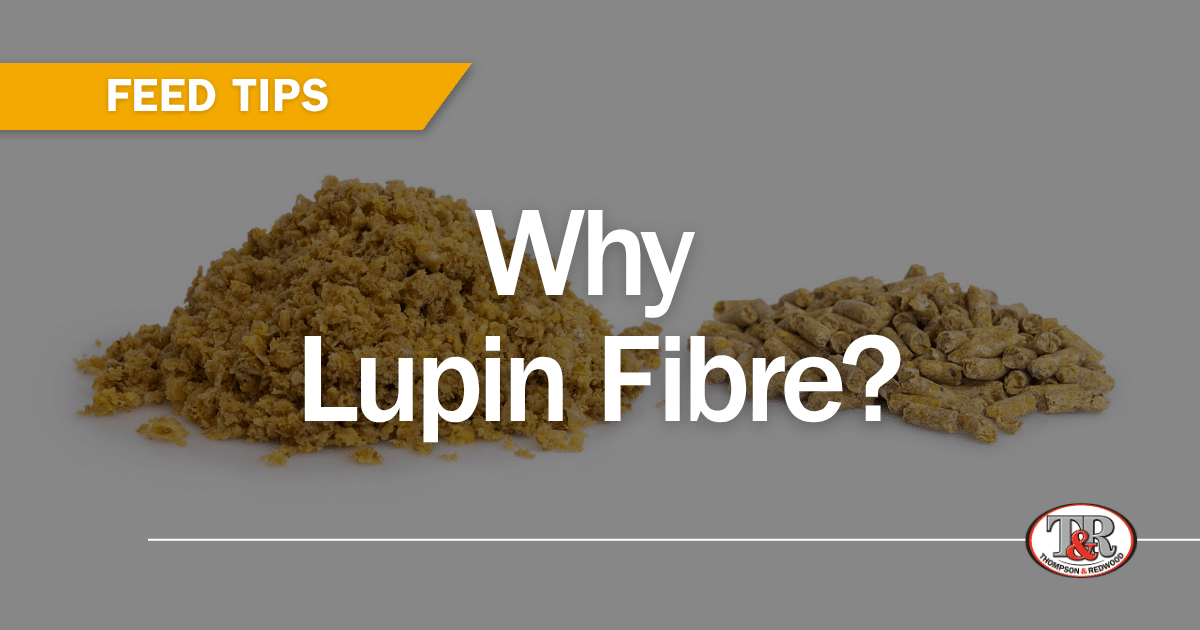
17 Aug Why feed Lupin Fibre Cubes or Lupin Fibre Boost instead of loose lupin hulls
Nutritionist Jill Davies explains that Lupin Fibre Cubes provide the same highly fermentable, low-starch fibre as loose lupin hulls but in a cleaner, easier-to-store format that can be soaked into a hydrating mash. Lupin Fibre Boost go a step further, supplying vitamins, minerals, pre & probiotics to provide more balanced nutrition for horses.
By Jill Davies, Equine Nutritionist
For owners who have been feeding loose lupin hulls, changing products can understandably feel unnecessary.
The aim is not to suggest that loose lupin hulls are a poor fibre source. Lupin hulls are a very useful, highly fermentable, low-starch and low-sugar fibre ingredient.
The advantage of the T&R lupin hull products is that they take that useful lupin fibre and make it more practical to feed, easier to store, more consistent, and in the case of Lupin Fibre Boost, provide a broader nutritional package designed with Western Australian hay and pasture in mind.
Lupin Fibre Cubes compared with loose lupin hulls
Lupin Fibre Cubes provide the same type of useful lupin-hull fibre, but compressed into a convenient cube.
The cube format offers several practical advantages:
- Easier and cleaner to store
- Less bulky in the feed shed
- Easier to transport
- Easy to weigh accurately
- Less light, loose material blowing around when feeds are prepared
- Can be soaked into a soft fibre mash
- Allows considerable additional water to be incorporated into the horse’s ration.
A simple way to describe it is:
The lupin fibre is compressed for convenience, then the bulk and water are added back in the bucket.
Once soaked, Lupin Fibre Cubes break down into a soft mash, making them particularly useful for:
- Senior horses
- Horses with worn or missing teeth
- Horses that struggle to chew adequate long-stem forage
- Travelling and competition horses
- Horses eating predominantly dry hay
- Horses where increasing water intake is desirable
- Horses requiring a very low-starch and low-sugar fibre carrier.
The advantage is not that cubing somehow makes the lupin hull nutritionally superior. It is about making a very useful fibre ingredient easier, cleaner and more versatile to use.
Lupin Fibre Boost compared to other lupin hulls products
Lupin Fibre Boost provides a broader nutritional package, including:
- Major minerals
- Trace minerals
- Iodine
- Selenium
- Fat-soluble vitamins
- Water-soluble vitamins
- Vitamin C
- Prebiotics
- Probiotics
- And a very low-starch, low-sugar fibre base.
This means Lupin Fibre Boost should be viewed as much more than simply lupin hulls made into a pellet.
Better distribution of vitamins and minerals
One practical advantage of incorporating nutrients into a pellet is consistency.
With any loose fibre product containing fine powdered vitamins and minerals, there is the possibility that some of those very fine particles can move or settle during:
- Transport
- Storage
- Repeated movement of the bag
- Scooping feeds over time.
Owners sometimes reach the bottom of a loose bag and find considerably more fine powder remaining.
That raises a very reasonable question:
“Has my horse been receiving the same amount of vitamins and minerals in every feed?”
When vitamins and minerals are incorporated into a pellet, there is less opportunity for those fine ingredients to separate from the fibre.
This helps provide greater confidence that each measured feed contains a more consistent combination of fibre, major minerals, trace minerals and vitamins from the beginning of the bag to the end.
Pelleting does not make the nutrients inherently better. The advantage is more consistent delivery.
Designed with Western Australian hay and pasture in mind
One of the important advantages of Lupin Fibre Boost is that its nutritional profile has been developed with the types of forages commonly fed to horses in Western Australia in mind.
WA hay and pasture can present a very different mineral profile from forage grown elsewhere.
Rather than simply adding a generic vitamin and mineral premix, the aim is to complement what WA horses are actually receiving from their forage.
This is particularly important in horses that spend much of the year on:
- Conserved hay
- Dry pasture
- Weathered pasture
- Combinations of WA pasture and hay that may already provide plenty of some minerals but comparatively little of others.
No unnecessary added iron
Many Western Australian horse diets already receive considerable iron from:
- Pasture
- Hay
- Soil contamination
- Drinking water (Occasionally)
Where iron is already plentiful in the forage, there is little benefit in routinely adding more through the bucket feed.
This can be particularly important for owners who are concerned about the overall iron load of their horse’s diet.
Instead, greater emphasis can be placed on nutrients such as copper and zinc, which need to be considered alongside the iron already supplied by the forage.
The message is not that iron is inherently bad. It is that we do not necessarily need to add more iron to a diet already supplying plenty.
Major minerals
Lupin Fibre Boost contributes to the horse’s major mineral requirements, rather than simply supplying a few trace minerals.
Major minerals are required in much larger quantities than trace minerals and play essential roles in:
- Skeletal health
- Muscle contraction and relaxation
- Nerve function
- Energy metabolism
- Fluid balance
- Many other metabolic processes.
This gives Lupin Fibre Boost a broader nutritional role than a simple fibre product.
The important point is not that every horse requires exactly the same amount of every major mineral. The value is that the product provides a nutritional base that can then be considered alongside the individual horse’s:
- Hay
- Pasture
- Workload
- Bodyweight
- Age
- Health
- Any additional supplements being used.
Copper and zinc
Copper and zinc are important trace minerals involved in:
- Hoof quality
- Skin and coat health
- Connective tissue
- Enzyme systems
- Antioxidant defence
- Immune function
In WA diets, it is particularly important to consider copper and zinc alongside the amount of iron already present in forage.
This is another reason why avoiding unnecessary added iron while supplying appropriate copper and zinc can be useful.
Iodine and selenium
Lupin Fibre Boost also provides iodine and selenium.
These nutrients can be difficult to rely on pasture and hay alone to supply consistently because their concentrations are strongly influenced by soils and forage.
Including iodine and selenium gives owners another level of nutritional support compared with simply feeding lupin hull fibre alone.
This is especially relevant in diets where most of the horse’s intake comes from locally grown WA forage.
Fat-soluble and water-soluble vitamins – including vitamin C
Another important difference with Lupin Fibre Boost is that it provides a broader range of fat-soluble and water-soluble vitamins, rather than simply supplying fibre and minerals.
This becomes particularly relevant for horses with:
- Little or no access to fresh green pasture
- Diets based predominantly on hay
- Long periods on dry summer pasture
- Older horses
- Horses in higher work
- Horses whose overall nutritional intake may be less reliable.
For many horses in Western Australia, access to actively growing green pasture can be limited for substantial parts of the year.
Once pasture dries and forage is conserved and stored, the supply of some vitamins can decline.
Lupin Fibre Boost therefore helps provide additional vitamin support within the daily ration.
This includes vitamin C, which can be particularly useful to consider in older horses and horses with minimal fresh pasture intake.
Although horses can synthesise vitamin C themselves, endogenous production may not always be as robust in older horses or during periods of increased physiological demand.
Providing vitamin C within the ration gives another level of nutritional support, particularly for senior horses and those relying heavily on conserved forage.
The benefit is therefore not simply:
fibre + minerals
but a broader package of:
fibre + major minerals + trace minerals + iodine + selenium + fat-soluble vitamins + water-soluble vitamins, including vitamin C.
Prebiotics and probiotics – additional hindgut support
Lupin Fibre Boost also contains prebiotics and probiotics, providing another level of digestive support alongside its fibre-rich lupin base.
The horse is a hindgut fermenter, and the microbial population of the caecum and colon plays a major role in the digestion of fibre.
Prebiotics help provide substrates that support beneficial microorganisms already present in the digestive tract, while probiotics are included to support a healthy microbial population.
This can be particularly useful when horses are experiencing:
- Feed changes
- Seasonal pasture changes
- Travelling or competition
- Older age
- Predominantly hay-based diets
- Sensitive digestive systems
- Diets where we are deliberately keeping starch intake low.
These ingredients do not replace good forage management or gradual feed transitions.
The foundation of hindgut health remains:
Adequate fibre + gradual dietary change + controlled starch and sugar intake + appropriate meal size + good forage management.
However, prebiotics and probiotics provide an additional level of support within that overall feeding program.
Greater control over salt
Another useful feature is not loading the fibre feed with unnecessary salt.
The amount of salt a horse requires varies considerably according to:
- Bodyweight
- Workload
- Sweating
- Temperature and humidity
- Forage intake
- Individual management.
Keeping the base feed lower in added salt allows the owner or nutritionist to add the appropriate amount of salt for that particular horse, rather than automatically increasing salt intake whenever more fibre feed is required.
This can also be useful for horses with sensitive gastrointestinal tracts, where we may want greater control over how much salt is provided in a single meal.
The point is not that salt itself causes ulcers or hindgut acidosis.
The benefit is greater control over total salt intake and how it is distributed through the day.
Very low starch and sugar
Another major advantage of both Lupin Fibre Cubes and Lupin Fibre Boost is their very low starch and sugar content.
This is particularly useful for horses and ponies with:
- Insulin dysregulation
- Equine Metabolic Syndrome
- Previous laminitis
- PPID with concurrent insulin dysregulation
- Obesity or easy-keeper tendencies
- Gastric ulcers
- Sensitive hindguts
- Horses where excessive starch reaching the hindgut is a concern.
For these horses, it is not enough simply to say that a feed is “low sugar” or “low starch.”
What matters is:
The concentration of starch and sugar in the feed × the amount fed in that meal.
A very low-NSC product therefore gives us greater flexibility to choose a feed amount appropriate for the individual horse without unnecessarily increasing the carbohydrate load of the meal.
Feeding according to the horse – not simply the bag
For horses with insulin dysregulation, we want to avoid unnecessarily large glucose and insulin responses after feeding.
The advantage of using a very low-starch and low-sugar fibre feed is that we can work backwards from the carbohydrate analysis and the horse’s bodyweight to determine an appropriate feed amount.
The amount can therefore be adjusted according to:
- Bodyweight
- Severity of insulin
- Dysregulation
- Current insulin results
- Hay NSC
- Pasture intake
- Body condition
- Workload
Everything else being fed in the same meal.
For horses requiring tight carbohydrate control, we can set an appropriate starch and sugar target for each meal and calculate the feed rate accordingly.
This is far more useful than simply telling every owner:
“Feed one scoop.”
The feeding rate should be appropriate for that individual horse and the whole diet.
Why very low NSC gives us more flexibility
The lower the starch and sugar concentration of the carrier feed, the easier it becomes to provide:
Fibre + minerals + vitamins + supplements
without using up a large proportion of the horse’s allowable starch and sugar intake.
That can be particularly valuable when the horse is already receiving carbohydrate from:
- Pasture
- Hay
- Another feed
- Other necessary ration components.
A low-NSC bucket feed cannot compensate for inappropriate pasture or high-NSC hay.
However, it does mean we are not unnecessarily adding another significant starch and sugar load through the bucket feed.
Useful for horses with ulcers and sensitive hindguts
For horses with gastric ulcers or sensitive hindguts, the important advantage is that lupin-hull-based feeds provide energy predominantly from fermentable fibre rather than relying heavily on cereal starch.
Keeping individual meals low in starch can help reduce the amount of starch potentially escaping small-intestinal digestion and reaching the hindgut.
This is why these fibre-based products can fit very well into diets where we are trying to support:
- Gastric health
- Hindgut stability
- Steady fibre fermentation
- A lower-starch overall ration.
The combination of:
very low starch and sugar + fermentable fibre + prebiotics + probiotics
also gives Lupin Fibre Boost a useful role in horses where digestive health is a priority.
The overall message to owners
The message should not be:
“Loose lupin hulls are bad and cubes are better.”
Instead:
“We have kept the low-starch, low-sugar lupin fibre you already value, but made it easier to store, measure and hydrate, and developed a fortified option providing a broader and more consistent vitamin, mineral and digestive-support package designed with WA forage in mind.”
Lupin Fibre Cubes
A straightforward, very low-NSC lupin-hull fibre.
Compress it for storage — add the bulk and the water back in the bucket.
Useful as:
- A fibre source
- A soft soaked mash
- A hydration feed
- A low-NSC carrier for supplements
- A fibre option for older horses or horses with poor dentition.
Lupin Fibre Boost
Low-NSC lupin fibre combined with a broader nutritional package providing:
- Major minerals
- Copper
- Zinc
- Selenium
- Iodine
- Fat-soluble vitamins
- Water-soluble vitamins
- Vitamin C
- Prebiotics
- Probiotics
- No unnecessary added iron
- Greater control over additional salt
- More consistent nutrient distribution through the pelleted format.
In Summary, the change is not simply:
loose fibre → pellet.
It is:
- Low-NSC lupin fibre
- More consistent nutrient delivery
- Major minerals
- Trace minerals
- Iodine and selenium
- Fat- and water-soluble vitamins
- Vitamin C
- Prebiotics and probiotics
- No unnecessary added iron
- Greater control over salt
- Easier storage and handling
accurate feeding - The ability to tailor the feed rate to the individual horse
- An excellent soaked fibre and hydration option.
For metabolic horses in particular, the advantage is that we can use a very low-starch and low-sugar fibre feed at an amount appropriate for the horse, helping us keep the carbohydrate load of each meal within the target we have set for that individual.
By Jill Davies


No Comments